1. Research Motivation
Autonomous Underwater Vehicles are used for ocean exploration, environmental monitoring, hydrographic surveys, underwater inspection, scientific observations, and subsea infrastructure assessment.
One significant operational limitation is the need to recover, recharge, or service these vehicles after completing their missions.
Underwater docking presents several engineering challenges:
- GPS signals cannot be used directly for submerged localization.
- Acoustic navigation measurements can be affected by noise, multipath propagation, and limited update rates.
- Ocean currents can introduce position and orientation disturbances.
- The AUV and floating docking station may experience different motion.
- Small positioning errors can result in failed docking attempts.
- Mechanical capture must avoid excessive stress on the vehicle.
- Underwater electrical connections require careful sealing, insulation, and safety management.
JAL-DOCK explores how localization, motion prediction, active robotic capture, and a controlled charging interface could be integrated into a single autonomous docking architecture.
2. Proposed System Architecture
The proposed JAL-DOCK system consists of five primary subsystems.
A. Autonomous Underwater Vehicle
The AUV performs underwater missions and returns to the docking station when its mission is complete or its battery reaches a defined return threshold.
Potential onboard components include:
- Inertial Measurement Unit (IMU)
- Inertial Navigation System (INS)
- Doppler Velocity Log (DVL)
- Acoustic positioning equipment
- Underwater camera or sonar
- Navigation computer
- Battery Management System (BMS)
- Motor and propulsion controllers
These devices would support navigation, guidance, docking preparation, and health monitoring.
B. Underwater Localization and Navigation
Since GPS is unavailable underwater, the system proposes combining inertial and acoustic measurements for position estimation.
The navigation architecture considers acoustic USBL measurements, INS, DVL, and IMU data.
An Extended Kalman Filter (EKF) is proposed to combine measurements and maintain an estimate of the AUV's position, velocity, and orientation.
The broader objective is to develop reliable navigation toward a docking station despite uncertainty and sensor disturbances.
C. Depth-Adjustable Floating Docking Station
The docking station is proposed as a moored underwater structure capable of controlled depth adjustment.
A buoyancy-control or tether-management mechanism could be investigated for positioning the station at a desired operating depth.
The docking station would include:
- Structural support frame
- Depth-adjustment mechanism
- Underwater sensing system
- Navigation reference equipment
- Robotic capture assembly
- Electrical charging interface
- Communication and monitoring electronics
The station is intended to provide a controllable docking environment while allowing limited motion caused by water conditions.
D. Four-Arm Robotic Capture System
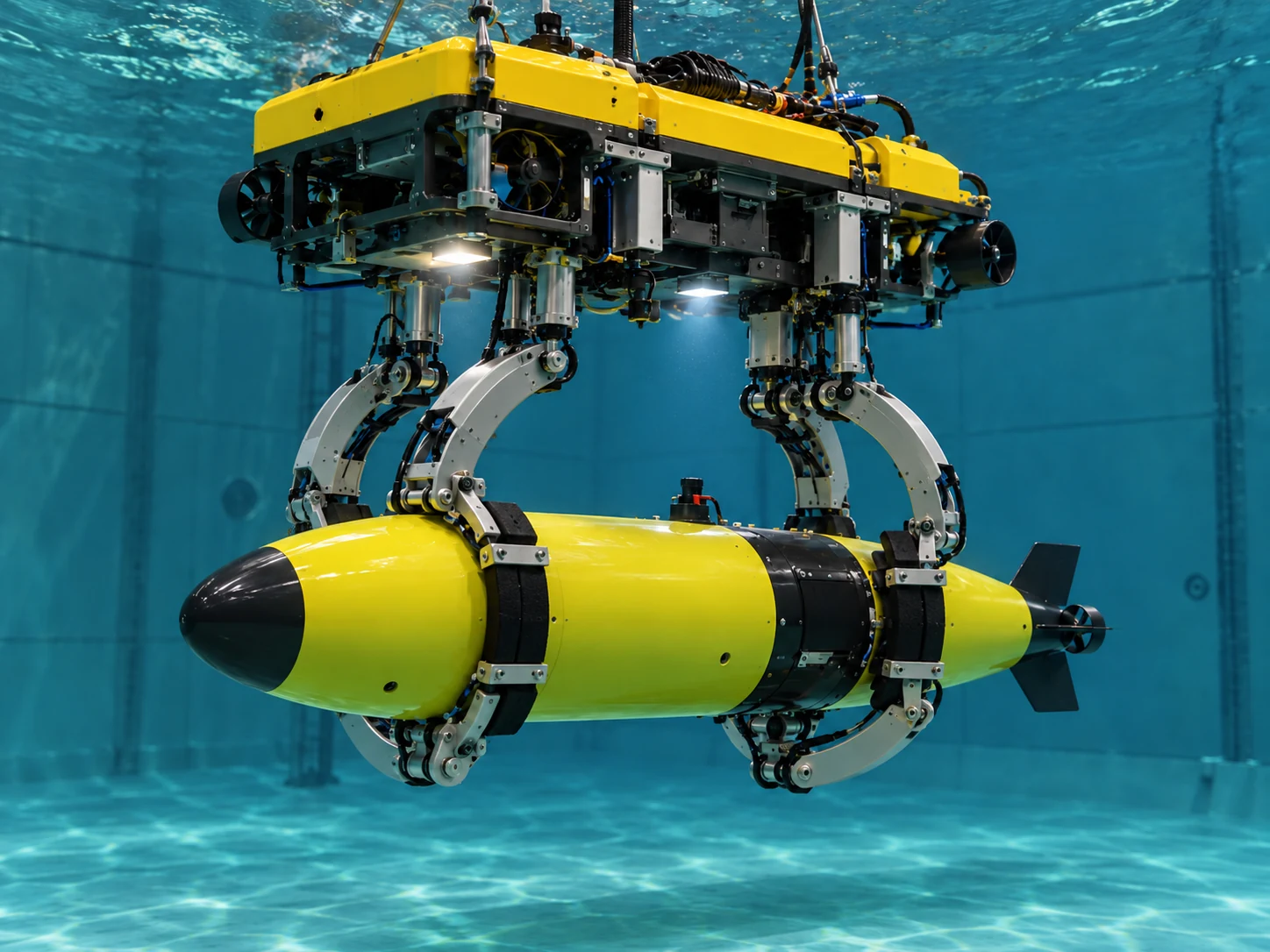
One of the main research features of JAL-DOCK is a mechanical capture arrangement using four curved robotic arms.
The arms are designed conceptually to operate in coordinated pairs around reinforced attachment areas on the AUV.
The robotic capture head may move along multiple controlled axes to improve alignment during the final docking stage.
The proposed sequence is:
- Detect the approaching AUV.
- Estimate the relative position and orientation.
- Align the robotic capture mechanism with the vehicle.
- Engage four capture arms around designated attachment structures.
- Apply controlled gripping force.
- Verify mechanical locking.
- Authorize the next docking and charging stage.
The capture mechanism is intended to engage engineered docking interfaces rather than compressing the vehicle's unreinforced pressure hull.
Future development will examine robotic inverse kinematics, position-feedback control, gripping-force limitations, compliant interfaces, and emergency-release procedures.
E. Direct-Contact Underwater Charging
JAL-DOCK proposes physical electrical charging rather than wireless inductive charging.
After the AUV has been captured and mechanically secured, an independently actuated underwater-rated connector would engage the vehicle's charging interface.
The charging sequence would require:
- Verified mechanical lock
- Connector alignment and controlled mating
- Electrical isolation and insulation checks
- Leakage and fault monitoring
- Battery and charging-system communication
- Controlled charging authorization
- Safe disconnection before vehicle release
The intended benefit is to investigate an efficient, controlled electrical connection while addressing the safety challenges of submerged power transfer.
3. Autonomous Navigation and Algorithms
The proposed autonomy system is organized into several technical functions.
GPS-Denied Localization
Proposed methods: INS, IMU, DVL, acoustic positioning, and Extended Kalman Filter sensor fusion.
Research objective: Estimate the vehicle's underwater state with improved robustness against navigation drift and measurement uncertainty.
Docking Station Detection
Proposed methods: Acoustic ranging and positioning for initial approach, followed by sonar or camera-based alignment when conditions permit.
Research objective: Locate the docking interface and estimate the AUV's relative pose during the final approach.
Autonomous Path Planning
Proposed methods: Waypoint guidance, energy-aware return planning, and relative-motion-based terminal guidance.
Research objective: Guide the AUV toward the station while accounting for available energy, vehicle motion, and disturbances.
Moving-Station Tracking
Proposed methods: Relative position and velocity estimation, motion prediction, and feedback correction.
Research objective: Investigate how the docking controller can compensate for movement of both the AUV and station.
Robotic Capture Control
Proposed methods: Inverse kinematics, position feedback, force-limited gripping, and mechanical lock verification.
Research objective: Coordinate the capture mechanism without generating unsafe contact forces or alignment errors.
AI-Based Perception
Computer vision and machine-learning techniques may be evaluated as part of future perception research.
Potential candidates include YOLO-based visual object detection and learning-based underwater sonar interpretation, depending on the available datasets and sensing conditions.
No experimentally validated, JAL-DOCK-specific trained underwater perception model is currently claimed.
4. Software Architecture and Preliminary Development
The software-oriented research is organized around modular control and simulation components.
Navigation Module
Represents vehicle movement and navigation measurements within a simplified simulated environment.
State Estimation Module
Defines how multiple navigation measurements could be integrated into a shared state estimate.
Guidance and Docking Module
Manages vehicle approach, alignment conditions, docking state transitions, and mission completion.
Robotic Capture Module
Defines proposed capture sequences, coordinated gripping, mechanical confirmation, and release logic.
Safety and Fault Management
Includes preliminary logic for conditions such as navigation failure, unsuccessful alignment, docking abort, and charging authorization.
Monitoring Dashboard
A preliminary software interface has been developed to demonstrate how docking status, navigation variables, mission progress, and safety-related events could be visualized.
Development tools used or explored:
- Python
- Numerical simulation and mathematical modelling
- HTML, CSS, and JavaScript
- Control-state logic
- Software testing and debugging
- AI-assisted engineering documentation and prototype development
These preliminary tools support concept exploration. They do not replace actual hardware control, sensor calibration, underwater experiments, or safety certification.
5. Research Questions
The JAL-DOCK research concept is structured around several open engineering questions.
Research Question 1: Can active robotic capture improve docking reliability when both the AUV and docking interface experience relative movement?
Research Question 2: How accurately must the relative position and velocity of the AUV be estimated to support safe mechanical capture?
Research Question 3: Can an actively positioned four-arm capture mechanism reduce alignment requirements compared with fixed docking interfaces?
Research Question 4: What control strategy can limit gripping forces while maintaining a stable mechanical connection?
Research Question 5: How can mechanical locking, underwater connector engagement, and electrical charging be integrated into a safe operational sequence?
These questions provide a basis for future modelling, experimental testing, and comparative performance evaluation.
6. Current Research and Development Status
The project has progressed through initial research planning and conceptual design activities.
Preliminary work includes:
- Identification of the underwater docking problem
- Review and comparison of relevant navigation and docking approaches
- Definition of the JAL-DOCK system architecture
- Selection of candidate navigation and localization methods
- Conceptual design of a depth-adjustable docking station
- Four-arm robotic capture mechanism concept
- Simplified mathematical and Python simulation work
- Preliminary autonomy and docking-state logic
- Proposed electrical charging safety sequence
- Initial control and monitoring dashboard prototype
- Future laboratory and underwater testing plan
The mechanical visualizations illustrate the proposed engineering arrangement and should not be interpreted as photographs of a manufactured JAL-DOCK prototype.
Not yet completed: Integrated hardware manufacturing, physical four-arm capture testing, subsea electrical mating, trained underwater sonar perception, full controller validation, and end-to-end underwater docking demonstrations.
7. Future Research and Development Roadmap
Phase 1 — Research Gap and Feasibility
Study existing underwater docking systems and identify the specific technical limitations that an active robotic capture system might address.
Target outcome: A focused research hypothesis and feasibility assessment.
Phase 2 — Mathematical Modelling
Develop coupled models of AUV dynamics, underwater station motion, relative positioning, environmental disturbances, and capture-system movement.
Target outcome: A validated mathematical and simulation framework.
Phase 3 — Navigation and Sensor Fusion
Evaluate acoustic positioning, inertial navigation, DVL measurements, sensor fusion, and predictive terminal guidance.
Target outcome: Improved docking approach performance in simulation.
Phase 4 — Mechanical Prototype
Develop a laboratory-scale capture-head structure with four actuated arms, position sensing, gripping-force feedback, and mechanical locks.
Target outcome: Bench-tested capture mechanism.
Phase 5 — Controller Development
Implement arm kinematics, motion synchronization, gripping-force control, and fault-safe release logic.
Target outcome: A repeatable and measurable mechanical docking controller.
Phase 6 — Comparative Experimental Testing
Compare a fixed docking interface, passive compliant mechanism, and active robotic capture system under controlled disturbances.
Target outcome: Quantitative evidence concerning alignment accuracy, capture success, contact forces, and docking reliability.
Phase 7 — Direct Electrical Charging Integration
Evaluate controlled connector engagement, underwater sealing, electrical interlocks, fault detection, and charging management.
Target outcome: A safe laboratory charging demonstrator.
Phase 8 — Underwater Validation
Progress from dry laboratory testing to controlled tank experiments and then, subject to safety approval, more realistic underwater environments.
Target outcome: Experimental data on docking success, system reliability, safety, and operational performance.
8. Potential Applications
If successfully developed and validated, the proposed architecture may have applications in:
- Autonomous underwater inspection
- Marine environmental monitoring
- Long-duration ocean observation
- Underwater infrastructure assessment
- Scientific AUV operations
- Subsea robotic servicing
- Repeated autonomous underwater missions
These are potential future applications, not claims of current deployment.
9. My Role and Technical Contribution
Abir Ghosh — Research Concept and Preliminary System Development
My contribution has focused on identifying the engineering problem, developing the proposed system architecture, exploring suitable navigation and control methods, preparing the four-arm robotic capture concept, and creating initial mathematical, software, and interface prototypes.
I have also explored research literature related to autonomous navigation, underwater docking, robotic control, and sensor integration to identify technical challenges requiring further investigation.
AI-assisted development tools have supported parts of the early research, modelling, documentation, and prototype preparation.
My objective is to advance the concept through deeper mathematical analysis, independently understood and verified software implementations, hardware integration, and experimental testing.
10. Research Outlook
JAL-DOCK represents an early-stage interdisciplinary research direction at the intersection of underwater robotics, localization, autonomous control, robotic manipulation, and subsea power systems.
The longer-term goal is to investigate whether a motion-aware robotic capture mechanism can improve the safety and repeatability of docking with an underwater vehicle.
Future work will prioritize measurable engineering performance, comparison with existing docking strategies, hardware feasibility, and experimental evidence.
The central research goal is not only to automate docking, but to study how reliable robotic capture can be achieved under uncertain underwater motion.
Project Development Disclaimer
JAL-DOCK is an independently developed research concept and preliminary engineering study.
The current visual designs, system diagrams, and software demonstrations represent conceptual or simulated work unless specifically identified as physical experiments.
The system has not yet been demonstrated as an integrated, underwater-tested docking and charging platform.
References to existing scientific work are intended to provide technical context and do not imply endorsement, collaboration, institutional affiliation, or ownership by the referenced researchers or institutions.
Explore the Research
Project: JAL-DOCK — Joint Autonomous Localization and Docking System
Researcher: Abir Ghosh
Topics: Underwater Robotics, AUV Docking, Robotic Capture, Sensor Fusion, Autonomous Navigation, Direct-Contact Charging
Available materials: Concept visualizations, research overview, preliminary software demonstrations, proposed system architecture, and development roadmap.
Interested in research collaboration, engineering review, or technical discussion? Get in touch to explore the concept and its future experimental development.